
Creative Beginnings
“In the beginning God created the heaven and the earth. And the earth was without form and void; and darkness was upon the face of the deep. And the Spirit of God moved upon the face of the waters. And God said, Let there be light: and there was light.” Genesis 1:1-3
“Begin at the beginning… and go on till you come to the end: then stop.” Lewis Carroll, Alice’s Adventures in Wonderland (1865)
“The capacity to be puzzled is… the premise of all creation, be it in art or science.” Erich Fromm (1959)
“The most wonderful inspirations die with their subject, if he has no hand to paint them to the senses.” Ralph Waldo Emerson, “Intellect,” Essays (184)
“To make a prairie it takes a clover and one bee,
One clover,and a bee,
And revery.
The revery alone will do,
If bees are few. ” Emily Dickinson
Creativity Truths
 “Genius at first is little more than a great capacity for receiving discipline.” George Eliot, Daniel Deronda (1876)
“To treat your facts with imagination is one thing, to imagine your facts is another.” John Burroughs, Journal
“Discontentment is at the root of the creative process… the most gifted members of the human species are at their creative best when they cannot have their way, and must compensate for what they miss by realizing and cultivating their capacities and talents.” Eric Hoffer, The Ordeal of Change (1964)
“I know that creation is an intellectual and bodily discipline, a school of energy. I have never achieved anything in anarchy or physical slackness.” Albert Camus (1950)
The Creative Process
 “Creativity is work that goes some place: it is sustained effort toward an ideal.” Michael Drury, Glamour, August 1963
“Everything vanishes around me, and works are born as if out of the void. Ripe, graphic fruits fall off. My hand has become the obedient instrument of a remote will.” Paul Klee, Swiss artist, Diary 1918
“Practice and thought might gradually forge many an art.” Virgil, Georgics, Book 1 (37-29 BC)
“I tell you there is no such thing as a creative haste.” Willa Cather, The Song of the Lark
“Could Hamlet have been written by a committee, or the Mona Lisa painted by a club? Could the New Testament have been composed as a conference report? Creative ideas do not spring from groups. They spring from individuals. The divine spark leaps from the finger of God to the finger of Adam…” Whitney Griswold (1957)
” ‘You have to learn to read faces,’ he told Sophie over and over again. ‘People’s faces are etched with their life stories. Then it’s up to you, the painter, to translate their stories onto the canvas as a visual language.’ ” Michele Zackheim, Broken Colors (2007)
The Artist
 “Every man is an exception.” Soren Kierkegaard
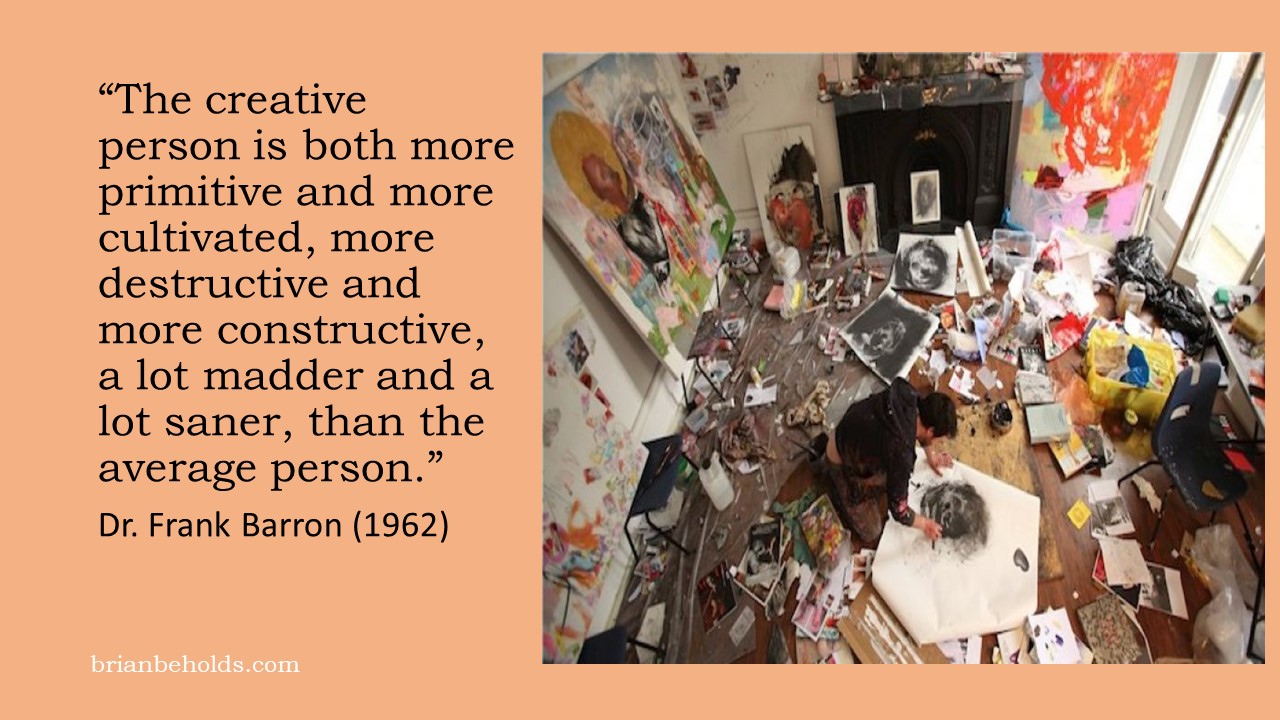
“The creative person is both more primitive and more cultivated, more destructive and more constructive, a lot madder and a lot saner, than the average person.” Dr. Frank Barron (1962)
“For me, painting is a way to forget life. It is a cry in the night, a strangled laugh.” Georges Rouault, French modernist, Look, 4/15/1958
“Hide not your Talents, they for Use were made. What’s a Sun Dial in the shade!” Benjamin Franklin, Poor Richard’s Almanack (October 1750)
“Life was meant to be lived, and curiosity must be kept alive. One must never, for whatever reason, turn his back on life.” Eleanor Roosevelt, The Autobiography of Eleanor Roosevelt, 1961
“Writing, I think, is not apart from living. Writing is a kind of double living. The writer experiences everything twice. Once in reality and once in that mirror which waits always before or behind him. … A double life is a a double burden. But it also has a double reward.” Catherine Drinker Bowen, Atlantic, 12/1957
“Listen carefully to first criticisms made of your work. Note just what it is about your work that the critics don’t like—then cultivate it. That’s the only part of your work that is individual and worth keeping.” Jean Cocteau, advice to a group of young artists, June 1956
” ‘My dear child,” Claire said, “of course I have people in my head! What a question! Every artist I know hears special voices, it’s part of the profession.’ ” Michele Zackheim, Broken Colors (2007)
Inspiration
 “No man was ever great without divine inspiration.” Maracus Tullius Cicero, De Natura Deorum (45 BC)
“That we have untapped potential for creativity is shown by the fact that most of us while asleep produce dreams far beyond our ordinary capacity for subtlety and range.” Gardner Murphy
“… The first of our senses which we should take care never to let rust through disuse is that sixth sense, the imagination… I mean the wide-open eye which leads us always to see truth more vividly, to apprehend more broadly, to concern ourselves more deeply, to be, all our life long, sensitive and awake to the powers and responsibilities given to us as human beings.” Christopher Fry, “On Keeping the Sense of Wonder,” Vogue, Jan 1956
“Ah, good taste! What a dreadful thing! Taste is the enemy of creativeness.” Pablo Picasso, Quote, 3/24/1957
“We copy when we lack the inclination, the ability, or the time to work out an independent solution.” Eric Hoffer, The True Believer (1951)
Importance of Creativity
 “To give a fair chance to potential creativity is a matter of life and death for any society. This is all-important, because the outstanding creative ability of a fairly small percentage of the population is mankind’s ultimate capital asset, and the only one with which only man has been endowed.” Arnold Toynbee
“Creation is a drug I can’t do without.” Cecil B. DeMille, New York Times, 8/12/1956
“I wonder whether art has a higher function than to make me feel, appreciate, and enjoy natural objects for their art value? So, as I walk in the garden, I look at the flowers and shrubs and trees and discover in them an exquisiteness of contour, a vitality of edge or a vigor of spring as well as an infinite variety of color that no artifact I have seen in the last sixty years can rival…. Each day, as I look, I wonder where my eyes were yesterday.” Bernard Berenson, Time, 4/25/1955
“Art comes to you proposing frankly to give nothing but the highest quality to your moments as they pass.” Walter Pater, Studies in the History of the Renaissance (1873)