
Childhood creativity is magical. A child can come up with ideas, visions and solutions that surprise adults. They can accept imperfections. They are clever in using materials and situations in unexpected ways. And they do it all without a sense of being critical of themselves or each other.
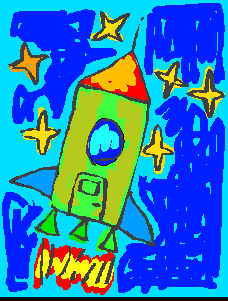
Beginner’s Luck: When You Don’t Know the Rules
Children have been absorbing language, behaviors and conventions since birth. They become what they have seen and heard. They are able to imagine and create worlds and dreams to the extent that they are allowed. If you tell a child something is impossible and impractical forcefully enough, they will believe it. Giving a child space to explore and create is not the same thing as anarchy. Children need discipline, limits and structure as much as any creative at any age.
Children are not afraid of art, or performing, or trying things, unless they feel an adult is hovering over them, judging them.
Play is the Thing
I remember long afternoons of being left to my own thoughts, my own inventions. I remember driving my bicycle around the neighborhood pretending I was driving a school bus, imagining my persona as a bus driver and who the kids were I was driving around. Traffic and other cars, and they way they react uniquely to school buses. Once I built a little model with my brother using our matchbox cars and objects found from both of our toy boxes to recreate my imagined route on the floor of the living room (with its green shag carpeting) on a rainy afternoon. I developed this concept over several months, off and on. It was me figuring out a social event from my own life in my own way and at my own pace.
Acting out other scenes from my limited life, like the school day or family eating and grooming rituals, was a big part of my early childhood. As I got older, the kinds of play I was engaged in changed.
Freedom, Garden Before the Fall
One vivid memory I have is from my first grade classroom: it was the week of Thanksgiving, and one of our class assignments was to paint a picture of a turkey. I worked on the body shape, the head shape, the feathers. I painted a fall foliage scene surrounding the turkey. Then I needed the turkey’s white eye to have an eyeball. I loaded my paintbrush with red paint and placed a dot int he center of the eye. A small trickle of red paint streaked down from the bottom of the eyeball. Quickly, I thought: Oh no! This isn’t supposed to be. Can I fix it? No, not really? Well, if I have time after it dries I could try to paint some white over the streak. But then I decided it looked cool, and nobody else had that on their picture so it was okay.
All the pictures were hung on the giant Venetian blinds over the large windows of our classroom. Nobody said anything was wrong with my picture, not even the teacher. When we left later in the week for our Thanksgiving holidays, I took my picture home and hung it on the refrigerator with magnets. Each member of my family said they liked it, but too bad about the streak on the eye.
Holding on to our Childhood
What I remember about my own childhood play is that I often abandoned activities when I got frustrated because I felt I could not do it. As I child I never thought of myself as smart or not smart, creative or not, athletic or not, I just was. But as I started seeing how others sorted things into good and bad, into better or worse, I started to abandon things I had previously enjoyed. This is a necessary part of growing up, and we cannot do everything in life, but I wonder how many of us may have discarded elements of our lives that could have been important and meaningful to us. If only we had a teacher or coach to encourage us, or at least not to tell us outright to give up.
Our lives become more complex. We have a larger world view. Responsibilities pile up. So do the signals, both verbal and nonverbal, overt and subtle, telling us that some things are appropriate and others are not. Even in the world of creative endeavors we learn there are techniques, rules and conventions we should follow. When We get stuck or to a “dead end” in our adult lives, it is a good idea to think back to how you were as a child. What things did you enjoy doing? Why did you stop doing them?